


Chatbots are transforming how real estate agencies operate by improving response times, capturing more leads, and automating repetitive tasks. Here’s what they bring to the table:
- Faster Lead Response: Chatbots reply in under 30 seconds, compared to the average agent’s 6-hour response time.
- 24/7 Availability: They handle inquiries anytime, ensuring no lead is missed – even at night or on weekends.
- Lead Qualification: Chatbots ask targeted questions to identify serious buyers and pass along qualified leads.
- Property Recommendations: Using natural language processing, they suggest properties based on user preferences in real-time.
- Scheduling Made Easy: Clients can book property tours instantly, with chatbot integration to agents’ calendars.
- Cost Savings: They reduce operational expenses by answering FAQs and managing routine tasks without additional staffing.
- Data Insights: Chatbots collect user data to improve lead segmentation and decision-making.
With 75% of U.S. brokerages already using AI, chatbots are now a must-have tool for staying competitive in real estate.
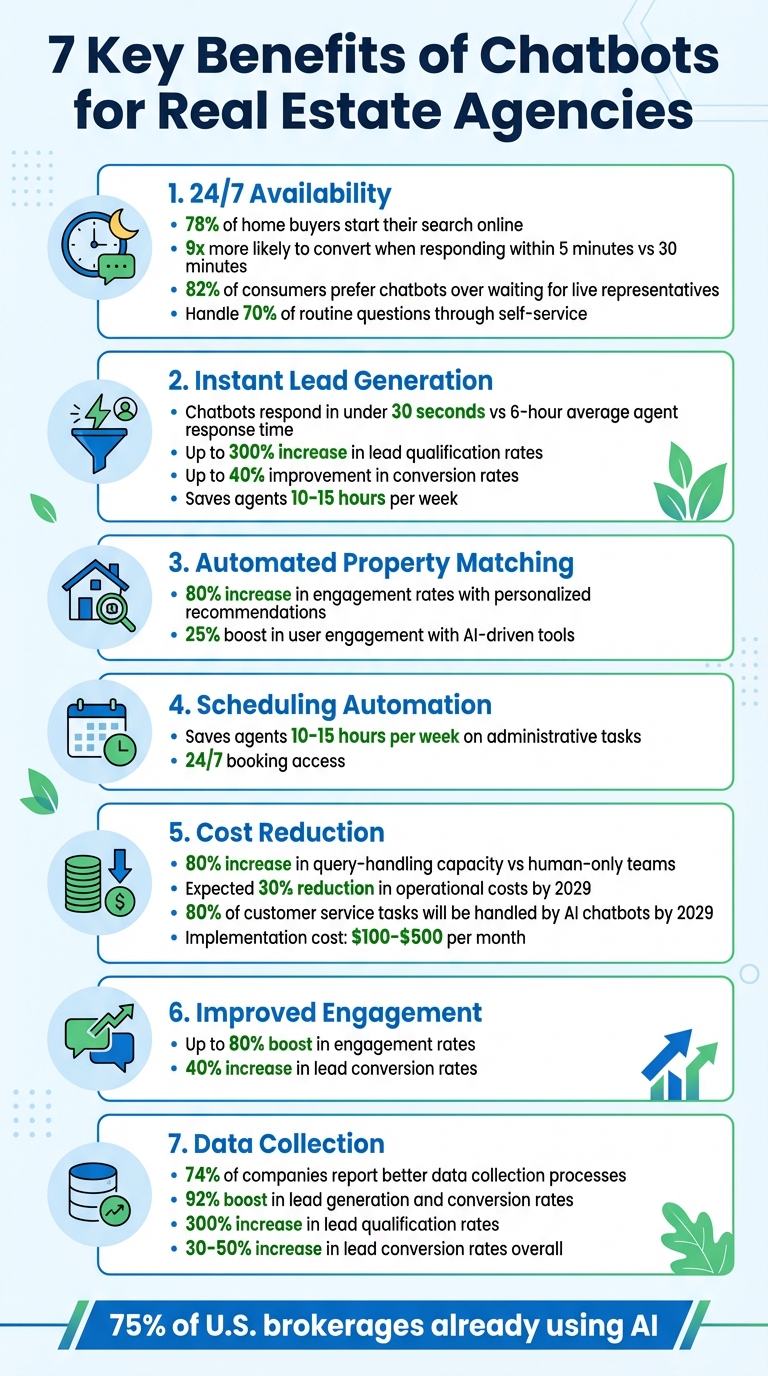
7 Key Benefits of Real Estate Chatbots: Statistics and Impact
How Chatbots Can 10x Your Lead Generation in Real Estate | with Hardik Makadia
1. 24/7 Availability for Customer Inquiries
78% of home buyers start their search online, and many of them browse outside the typical 9-to-5 window. A chatbot ensures that when a potential buyer visits your website at 11:00 PM on a Saturday, they get an immediate response instead of waiting until Monday morning. Quick responses matter – responding within 5 minutes makes you 9 times more likely to convert a lead compared to a 30-minute delay. This kind of round-the-clock availability ensures no lead slips through the cracks.
Think of a chatbot as your tireless digital receptionist. It can instantly provide details about properties, pricing, and amenities, and even schedule tours on the spot. Unlike human agents who can only handle one conversation at a time, chatbots juggle multiple inquiries simultaneously, eliminating wait times.
Here’s another reason to consider chatbots: 82% of consumers prefer interacting with an AI chatbot over waiting for a live representative. They can handle up to 70% of routine questions through self-service, leaving your agents free to focus on closing deals. For real estate agencies working with out-of-state or international buyers across various time zones, this 24/7 accessibility becomes a game-changer.
"A chatbot acts as an intelligent filter. It warms up leads and gathers the important details so that when you finally step in, the conversation is already miles ahead." – ChatbotGen
With a chatbot, there’s no such thing as a missed opportunity. It collects contact details, qualifies leads by asking about their budget and timeline, and passes along a warm prospect to your team by the next morning. This constant responsiveness is a key piece in streamlining lead management and boosting conversions.
2. Instant Lead Generation and Qualification
Every moment without a response risks losing a potential lead. While the average agent takes over six hours to reply to inquiries, chatbots can respond in under 30 seconds – a game-changer when many buyers only contact one agent before making a decision.
Chatbots don’t just respond quickly; they also gather essential details to separate serious buyers from casual browsers. By asking targeted questions, they collect information like budget, location, timeline, number of bedrooms, and mortgage pre-approval status. This financial pre-qualification helps agents understand a prospect’s buying power before they even pick up the phone.
This streamlined approach leads to measurable results.
"The chatbot’s primary goal is to qualify interest on the spot. It systematically gathers the essential data – budget, location, timeline, and even pre-approval status – that separates serious buyers from casual browsers." – ChatbotGen
Agents using AI chatbots have reported up to a 300% increase in lead qualification rates and conversion rate improvements of up to 40%. For example, in 2023, Newzip leveraged AI-driven personalization to boost user engagement by 60% and increase conversions by 10% within just a few months. This efficient system ensures agents spend more time closing deals rather than chasing cold leads.
When a chatbot identifies a high-intent lead – like someone with a $500,000 budget planning to move within three months – it instantly connects them to a live agent or schedules a property tour through calendar integration. This smart filtering process saves agents 10–15 hours per week, freeing them to focus on clients ready to make a purchase.
3. Automated Property Matching and Recommendations
Chatbots make property searches much easier by using natural language processing (NLP) to understand specific requests like, "Show me 3-bedroom homes under $500,000 near downtown". This technology allows users to interact naturally, without the need for complicated filters or forms.
These bots guide users step-by-step, starting with budget, then moving to location and property type, reducing the hassle of traditional searches. By pulling live data from Multiple Listing Service (MLS) feeds and CRM systems, chatbots ensure that every recommendation is up-to-date and accurately priced. This real-time functionality means clients won’t waste time on properties that are already off the market, creating a smoother and more engaging experience.
Personalized recommendations are a game changer, increasing engagement rates by up to 80%. On top of that, AI-driven tools overall can boost user engagement by 25%. Advanced chatbots even analyze browsing habits, picking up on subtle preferences – like a user frequently lingering on listings with large backyards or sleek, modern designs – and refining future suggestions based on these insights.
Once the chatbot identifies potential matches, it presents tailored options complete with images, detailed descriptions, and even virtual tour links – all within the same conversation. This seamless process not only satisfies buyers quickly but also provides real estate agents with pre-qualified leads. These leads come enriched with valuable insights about client preferences, making follow-up interactions more efficient and productive.
To maximize effectiveness, integrate your chatbot with MLS feeds to avoid showcasing unavailable properties. Additionally, features like smart triggers – for example, activating the bot after a user spends 30 seconds on a property page – can further improve completion rates and keep users engaged.
4. Scheduling and Appointment Automation
Chatbots make scheduling a breeze by connecting directly to agents’ calendars. This gives clients the ability to check real-time availability and book appointments instantly – even if it’s 11 PM on a Saturday night. With 24/7 booking access, you won’t lose potential leads just because they’re browsing after regular business hours.
These bots seamlessly sync with tools like Google Calendar, Outlook, and CRM platforms, eliminating double-bookings. Plus, they send instant confirmations, SMS or email follow-ups, and even allow clients to reschedule or cancel through the chat interface – all of which help reduce no-shows. This streamlined system not only simplifies scheduling but also saves agents a considerable amount of time.
In fact, automating scheduling can save agents 10–15 hours each week by cutting down on administrative tasks. All booking details are automatically logged into your CRM, so appointment history and lead data stay organized without the hassle of manual data entry.
Some advanced bots take it a step further by assigning the right agent based on factors like property location or specific expertise. This ensures clients are paired with the most suitable specialist while also reducing unnecessary travel time.
"Bad scheduling doesn’t just waste time. It eats into revenue. One missed call becomes a lost job. One no-show throws off your day." – ServiceAgent.ai
To get the most out of this system, consider enabling travel buffers and deploying the chatbot across multiple platforms – your website, SMS, WhatsApp, and Facebook Messenger. This way, clients can book appointments wherever they feel most comfortable.
sbb-itb-2f9da9d
5. Cost Reduction and Operational Efficiency
Chatbots act like a digital receptionist, handling initial inquiries and routine tasks without adding to your payroll. They’re available 24/7, managing basic questions, collecting contact details, and addressing FAQs – all without requiring night-shift staff. This ensures your agency maintains a professional presence around the clock, which is especially helpful during peak traffic or major property launches.
The real savings come from their ability to filter leads. By automating questions about budget, timeline, and location preferences, chatbots ensure your team spends time only on high-intent prospects. In fact, they can resolve up to 70% of queries instantly through self-service, freeing your staff to focus on closing deals instead of answering repetitive questions. This kind of operational streamlining directly contributes to higher profitability.
One standout feature of chatbots is their scalability. Unlike human employees, a single chatbot can handle thousands of conversations at once. This makes them invaluable during high-traffic periods or large-scale property launches, eliminating the need to hire extra personnel. Real estate firms using AI chatbots have reported an 80% increase in query-handling capacity compared to human-only teams. By 2029, AI chatbots are expected to manage 80% of common customer service tasks, potentially cutting operational costs by 30%.
The cost of implementing an AI chatbot ranges from $100 to $500 per month, depending on the features and lead volume. That’s just a fraction of what you’d spend on even a part-time employee. And when you factor in the time saved on tasks like data entry, scheduling, and lead qualification, the return on investment often becomes clear within just a few months.
6. Improved Client Engagement and Personalization
Searching for properties the old-fashioned way can be frustrating – irrelevant listings, clunky filters, and endless scrolling often leave buyers overwhelmed. Chatbots completely change the game by focusing on what each client truly cares about. Whether it’s budget, favorite neighborhoods, number of bedrooms, proximity to schools, or even style preferences like modern versus traditional, these bots remember and prioritize individual needs.
Instead of forcing users to fill out rigid forms, chatbots gather details naturally through conversation. For instance, a buyer might type, "Show me 3-bedroom homes under $500,000 near downtown", and the chatbot instantly responds with results that fit the request. Some advanced systems even track browsing habits to suggest properties that match unspoken preferences. This level of personalization can boost engagement rates by up to 80% in real estate applications. It not only makes the search process smoother but also creates a foundation for ongoing, tailored communication.
What makes chatbots particularly powerful is their ability to nurture relationships over time. They can send personalized updates, such as market trends, price drops, or new listings, all based on a client’s previous searches. This keeps your agency front and center without the need for constant manual follow-ups. And when a lead is ready to talk to an agent, the chatbot hands over the entire chat history, ensuring a seamless transition.
"A well-personalized chatbot makes prospects feel like they’re chatting with a knowledgeable assistant rather than a generic bot." – Realtor.com
Real estate teams using AI chatbots have seen lead conversion rates climb by as much as 40%. This success largely comes down to the trust built through personalized, meaningful interactions.
7. Data Collection and Insights for Better Decisions
Every chatbot interaction is a treasure trove of information, capturing user questions, search habits, and even where conversations fall off. This data offers a clear window into what your audience wants.
Through natural conversations, chatbots gather key details like budget, preferred neighborhoods, property types, and move-in timelines. They also track behavioral trends – such as which listings attract the most clicks, how long users stay engaged, and at what points they exit the chat. In fact, 74% of companies using automated agents report better data collection processes. When integrated with tools like Salesforce, HubSpot, or Zoho, this data becomes actionable almost immediately. That means businesses can use these insights to make smarter decisions on the fly.
For example, if you notice users consistently dropping off at a specific point in the conversation, it’s a clear sign to refine that part of the process. This kind of optimization pays off: companies that use chatbots in their marketing strategies have seen a 92% boost in lead generation and conversion rates. Beyond just improving lead generation, these insights allow businesses to segment prospects with laser precision.
Chatbots also take the guesswork out of lead segmentation. They automatically sort leads by intent and readiness to act, enabling your team to focus on the most promising opportunities. Real estate professionals using AI chatbots have reported up to a 300% increase in lead qualification rates compared to traditional methods. That’s efficiency and effectiveness rolled into one.
Conclusion
Chatbots have become a game-changer for real estate agencies aiming to thrive in today’s fast-paced market. These tools handle routine tasks like answering FAQs, qualifying leads, and scheduling appointments, freeing up agents to focus on what truly matters – building relationships and closing deals. Agencies that incorporate chatbot technology report impressive results, including a 30–50% increase in lead conversion rates and saving an average of 10–15 hours per week per agent. It’s not just about saving time; it’s about reshaping how modern real estate operates.
Beyond efficiency, chatbots significantly cut costs – by approximately 30% – and enhance the customer experience. In fact, 82% of consumers prefer interacting with chatbots over live agents. And speed? It’s critical. A response time of just five minutes makes a lead nine times more likely to convert. These numbers highlight how chatbots can position your agency as both smarter and more connected.
"A chatbot is a tool to augment your skills, not replace them. It frees you up to do what you do best: build relationships, negotiate deals, and close sales." – ChatbotGen
If you’re ready to see these benefits firsthand, consider Growth-Realty’s WhatsApp chatbots. They offer AI-powered lead generation, seamless CRM integration, and 24/7 availability to connect with prospects.
With 75% of U.S. brokerages already leveraging AI, the choice is clear: Will you let chatbots handle the routine so your agents can focus on closing deals, or risk being left behind?
FAQs
How can chatbots help real estate agents qualify leads more effectively?
Chatbots streamline lead qualification by engaging potential clients around the clock. They ask specific, targeted questions – like budget, property preferences, and desired timelines – to quickly assess a client’s needs. This helps identify serious buyers or sellers while filtering out inquiries that may not be relevant.
Beyond just initial engagement, chatbots handle follow-ups, schedule appointments, and even provide tailored property recommendations. By automating these tasks, they free up agents to focus on closing deals, ensuring that high-quality leads are nurtured efficiently and improving the chances of turning prospects into loyal clients.
How much does it cost to implement chatbots for real estate agencies?
The price tag for integrating chatbots into a real estate agency can differ greatly based on the features you want. Simple chatbot systems might cost just a few hundred dollars per month. On the other hand, more sophisticated options – offering features like AI-powered conversations, virtual property tours, or CRM integrations – can range anywhere from $10,000 to over $50,000 for development.
While the upfront costs might seem steep, chatbots can pay off in the long run. They handle repetitive tasks, engage leads more effectively, and simplify communication with clients. These time-saving and efficiency-boosting capabilities often make them a smart investment for real estate businesses.
How do chatbots enhance client engagement and create a personalized experience in real estate?
Chatbots enhance client engagement by delivering instant, around-the-clock responses to questions, ensuring that potential clients always get the assistance they need without waiting. Acting as digital assistants, they can initiate conversations, guide users to relevant property listings, address financing queries, and even help schedule property tours. This smooth, efficient interaction keeps clients interested and builds confidence in the service.
What’s more, chatbots offer a tailored experience, recommending properties based on a user’s preferences and online behavior. By making clients feel heard and valued, chatbots strengthen relationships and boost the likelihood of turning inquiries into serious, qualified leads.

