


Want to turn social media followers into loyal clients? Combine social media’s reach with email’s direct impact.
Here’s why this works:
- Email delivers $42 for every $1 spent and converts 40% better than social media.
- Social media builds attention, while email nurtures leads into action.
- Integration helps collect emails from social platforms, automate follow-ups, and retarget prospects effectively.
Key Steps to Success:
- Use social posts to promote gated content (like home valuation tools) and grow your email list.
- Keep branding consistent across emails and social posts.
- Segment your audience (buyers, sellers, etc.) for tailored campaigns.
- Automate workflows to sync leads between platforms and follow up quickly.
- Track performance metrics to refine strategies (email open rates, social engagement, etc.).
The Bottom Line: Social media grabs attention, but email converts leads into clients. By connecting these channels, real estate professionals can build trust, stay top-of-mind, and close more deals.
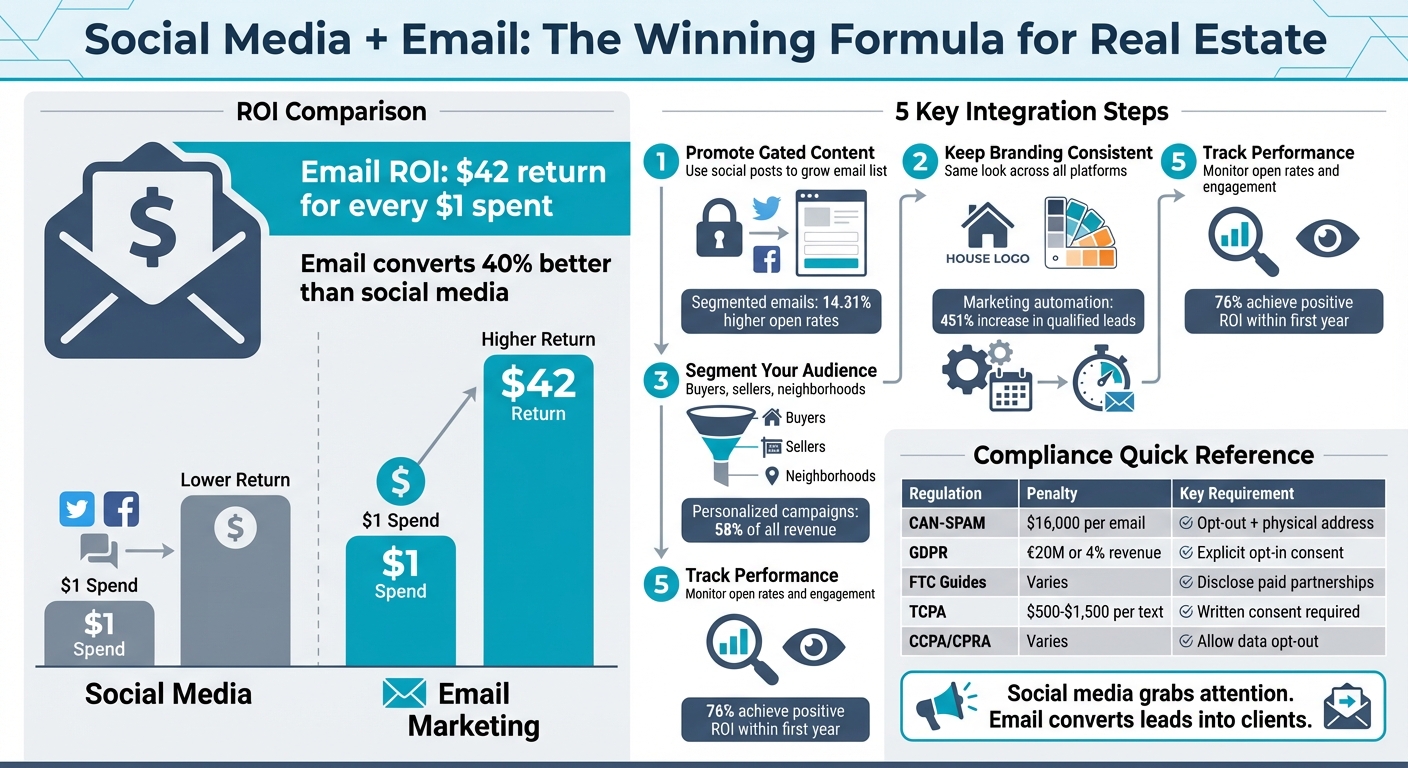
Social Media vs Email Marketing ROI and Compliance Requirements for Real Estate
Creating a Unified Social Media and Email Strategy
Keeping Your Message Consistent
Your brand should feel cohesive, whether someone encounters your Instagram post or opens your email. To achieve this, design five branded templates tailored for key content types – like testimonials, market statistics, and listing spotlights. Use the same fonts, colors, and logo placement across all platforms to ensure your brand is instantly recognizable.
Follow the 90/10 rule when crafting your content: dedicate 90% of your efforts to providing value – such as market insights, home maintenance tips, or local community updates – and use the remaining 10% for promotional content. Reinforcing your message with consistent visuals across platforms strengthens your brand identity.
Coordinate your calls to action (CTAs) across channels. For instance, if your Instagram bio highlights a free home valuation tool, make sure your email signature links to the same resource. Similarly, if you share a neighborhood guide on Facebook, send a follow-up email that dives deeper into the same topic. This unified approach ensures your audience receives a clear and consistent message.
Finding and Segmenting Your Audience
Once your brand voice is consistent, focus on refining your audience targeting. Use your CRM as a central hub to log and manage all lead data. Segment your audience into groups like buyers versus sellers, specific neighborhoods or zip codes, and even by lead lifecycle stages. This allows you to tailor content effectively – for example, sending "how to choose a realtor" guides to new leads and offering remodeling tips to past clients.
Why does segmentation matter? Targeted emails achieve a 14.31% higher open rate compared to generic ones, and personalized campaigns generate 58% of all revenue. Behavioral tracking can also help identify high-priority leads. For example, a subscriber who clicks on multiple listing emails in one week might benefit from a personal follow-up, while less active contacts might respond better to a re-engagement campaign on social media.
Tools like the Meta Pixel can track which listings prospects view on your website and the searches they save. You can even upload your email list to create custom audiences for retargeting ads. Personal touches, like including the recipient’s name or neighborhood in subject lines, can increase open rates by 29%.
Repurposing Content for Multiple Channels
One high-quality piece of content can fuel multiple campaigns across different platforms. For example, a single property listing can be transformed into an Instagram carousel (5–7 images), a 15–30 second TikTok or Reel, a "Just Listed" email blast, and a detailed feature in your monthly newsletter. Marketers who repurpose content are 2.5 times more likely to achieve strong results compared to those creating everything from scratch.
Tailor your content for each platform. Crop listing photos into vertical formats for Instagram Stories and Reels, and use high-resolution "hero" images in your email headers.
Social media can also help drive email sign-ups. Promote gated content – like eBooks, seller checklists, or exclusive market reports – that requires users to provide their email address. Once someone downloads your guide, they’re added to your email list for future nurturing campaigns. To keep the momentum going, add social share buttons to your email newsletters and include "link in bio" CTAs on social posts. This cross-promotion turns followers into subscribers and subscribers into clients.
Technical Setup and Tools
Using CRM Systems to Connect Platforms
Set up your social media lead forms to feed directly into your CRM. This allows you to follow up with potential leads via email within the critical first hour – timing that can make all the difference. Use tracking tools to gather retargeting data, enabling your CRM to deliver personalized social media ads or follow-up emails to website visitors. You can even upload your CRM’s email lists to platforms like Facebook and Instagram to target existing leads with ads. In 2023, 36% of Realtors credited their CRM systems for generating their highest-quality leads, while agents using marketing automation experienced a 30% boost in converting leads into customers. This kind of integration lays the groundwork for the email and social strategies discussed further below.
Adding Social Media Links to Emails
Keep your email design clean by limiting social media icons to the two or three platforms where you’re most active – usually Facebook, LinkedIn, and Instagram. Too many icons can clutter your email, so place these links strategically, either at the top of your email template or near your signature, where they’re easy to spot.
Use action-oriented CTAs that inspire trust and encourage engagement. For example, swap "Learn More" with "Connect with an expert" or replace "Call now" with "Let’s get in touch". Adding social sharing buttons to high-value content, like market reports or featured listings, makes it easier for recipients to share your material. Another option? Embed QR codes in your emails to offer exclusive perks, such as access to private social groups or special discounts, creating a seamless bridge between email and social media channels.
Automating Tasks Between Platforms
Once your platforms are connected and your links are in place, automation can take your workflow to the next level. Tools like Zapier make it possible to link your email marketing software with social media accounts, creating automated workflows that trigger actions across apps. For instance, when a prospect fills out a Facebook Lead Ad, a Zap can automatically add them to an email sequence in your CRM. Businesses that adopt marketing automation report a 451% increase in qualified leads, with 76% achieving a positive ROI within the first year.
Set up trigger-based workflows to log interactions, like Facebook Messenger or Instagram DMs, directly into your CRM. This ensures your sales team has a complete, unified view of customer activity. Additionally, automate instant notifications to route high-priority leads to the right agent. Don’t forget to establish quiet hours (8 PM–8 AM) to avoid sending late-night messages that could come across as unprofessional.
"The combination of Facebook Lead Ads integrated with HubSpot’s marketing automation platform makes certain that this information is delivered to the right audiences in the most seamless, frictionless way possible." – Tim Morse, Digital Marketing Manager, Element Three
What Is Social Media Email Integration And Why Use It? – TheEmailToolbox.com
sbb-itb-2f9da9d
Staying Compliant with Regulations
Compliance plays a crucial role in ensuring that your marketing campaigns are both effective and legally sound. By aligning your technical and data practices with regulatory standards, you can safeguard your business while building trust with your audience.
Key Compliance Rules to Follow
When integrating email and social media campaigns, you’ll need to navigate various legal requirements. For example, the CAN-SPAM Act regulates commercial emails and mandates accurate header details, honest subject lines, a valid physical postal address (like a street address or P.O. box), and a clear opt-out option. Violating these rules can lead to fines of up to $16,000 per email. If your audience includes individuals in the European Union, you’ll also need to comply with GDPR, which requires explicit opt-in consent rather than just offering an unsubscribe option. GDPR violations can result in penalties as high as 20 million euros or 4% of annual global revenue, whichever is greater.
The FTC Endorsement Guides are essential for campaigns involving influencers or sponsored social media posts. These guidelines require you to disclose any "material connections", such as payments or free services, between your business and those promoting your listings. Meanwhile, California’s CCPA and CPRA provide residents with rights to access, delete, and opt out of the sale or sharing of their personal data. For text message marketing, the TCPA requires prior express written consent, with potential penalties ranging from $500 to $1,500 per message.
| Regulation | Focus Area | Key Requirement |
|---|---|---|
| CAN-SPAM | Email Marketing | Opt-out mechanism and physical address |
| FTC Endorsement Guides | Social Media/Influencers | Disclose material connections |
| CCPA/CPRA | Data Privacy (California) | Allow users to opt out of data sales/sharing |
| TCPA | Text Messaging | Require prior written consent |
| GDPR | Data Privacy (EU) | Explicit opt-in consent |
These regulations emphasize the importance of strong data protection practices.
Protecting Client Data
Sharing data between email lists and social platforms introduces risks, so implementing security measures is essential. Use SPF, DKIM, and DMARC email authentication protocols to confirm your emails are authentic and to prevent phishing attacks. These measures also improve your email deliverability. Additionally, make your privacy policy easily accessible, detailing how you collect, use, and protect customer data, as well as how they can exercise their rights. Under GDPR, you’re required to report any data breaches to authorities and affected individuals within 72 hours.
"Creating a privacy policy is how businesses must comply with the transparency requirements set by these laws." – Termly
Data privacy concerns have a tangible impact – around 80% of consumers have abandoned a brand due to privacy issues. To maintain trust, ensure tools like Meta Pixel or LinkedIn Insight Tag respect user preferences captured through a Consent Management Platform. Remember, you’re also accountable for your marketing partners’ actions. If an agency you hire violates CAN-SPAM, your business could still be held responsible.
Getting and Managing Permission
Adopting a double opt-in process ensures you gather verified consent. This involves sending a confirmation email that subscribers must respond to before being added to your list. Avoid pre-checked boxes, as affirmative consent is required under GDPR and similar regulations. When collecting emails through platforms like Facebook Lead Ads or Instagram forms, clearly explain that subscribers will receive emails and may see retargeted ads.
"Obtaining consent is not only common courtesy, but it is required by anti-spam and other privacy and consumer protection laws." – ActiveCampaign
To comply with CAN-SPAM, process unsubscribe requests within 10 business days. Keep detailed records of when, where, and how consent was obtained, as these logs can be critical during audits. Regularly clean your email list by removing inactive subscribers and bounced emails. This not only protects your sender reputation but also aligns with data minimization principles. Every marketing message – whether it’s an email or text – must include a clear and functional opt-out option.
Tracking Performance and Making Improvements
To make smarter decisions, you need to measure your integrated campaigns effectively.
Metrics That Matter
When it comes to email marketing, keeping an eye on the right metrics is key. Real estate emails often aim for a 35–40% open rate, though the average for Realtors is closer to 19.7%. The click-through rate (CTR) – a great indicator of how well your content resonates – should ideally land between 2–5% or higher. To maintain a good sender reputation, keep your bounce rate below 2%, your unsubscribe rate under 0.5%, and spam complaints below 0.3%.
On social media, engagement rates matter more than just tallying up followers.
"For our clients, the KPIs are pretty simple: It’s leads, revenue generated, and Cost Per Acquisition." – Lane Rizzardini, Co-Owner of Marion Relationship Marketing
A healthy follower growth rate is around 2–3% monthly. To measure how well your social media efforts feed into other platforms, track how many followers convert into email subscribers through lead magnets or gated content.
At the end of the day, the conversion rate is what really counts. This metric shows the percentage of people taking meaningful actions, like scheduling a home showing or requesting a property valuation. In real estate, a good conversion rate falls between 1–3%. Segmented campaigns can make a huge difference here – targeted emails have been shown to drive a 760% increase in revenue and achieve a 14.31% higher open rate compared to generic ones.
Use these insights to fine-tune your campaigns and make them work harder for you.
Using Data to Improve Your Campaigns
Once you’ve got your data, it’s time to dig in and spot trends. For example, if you notice that Instagram posts about certain property types perform well but email open rates for similar content lag, you might need to rethink how you distribute your messaging. Multi-touch attribution can also help you understand the 6–8 interactions typically required before a conversion, giving you a clearer picture of where to allocate your budget across the entire customer journey – not just the final click.
Lead scoring is another powerful tool. By assigning points to contacts based on their actions across multiple channels, you can identify your most valuable leads. Dive into your customer journey to pinpoint where prospects drop off, then create specific content to address those weak spots.
"Dashboards are great because they allow the entire team to see the KPIs and data they need daily to make good decisions." – Brian Ferritto, Partner at 42connect
Breaking down data silos within your CRM can also reveal how different channels interact. For instance, you might find that engaging with prospects on social media increases the likelihood that they’ll open your emails.
Testing Different Approaches
Once your data reveals areas for improvement, testing can help you zero in on solutions. A/B testing is a great way to replace guesswork with reliable insights. Test one variable at a time – like subject lines, CTAs, or send times – to figure out what works best. Start with a hypothesis, such as "Adding emojis to email subject lines will boost open rates" or "Property videos on Instagram will get more clicks than static images".
Let your tests run for at least two weeks to ensure the results are statistically significant. Make sure your test groups are similar in size and demographics to avoid skewed data. Since over half of emails are opened on mobile devices, it’s also crucial to test how your content looks on smaller screens – pay attention to font sizes, button placement, and overall readability.
Small tweaks can make a big difference. Swap vague CTAs like "Learn More" for specific ones like "Find Out How Much Your Home Is Worth". Also, see if high-performing content from one platform – like a successful Facebook ad – can be adapted for another, such as an email subject line. Personalized CTAs, in particular, can be a game-changer, converting 202% better than generic ones. And as user behavior evolves, don’t forget to re-test periodically to keep your strategies fresh and effective.
Conclusion
Key Takeaways
For real estate professionals aiming to stay ahead, combining social media with email marketing is a must. Think of social media as "rented land" – subject to algorithm changes – while email is "owned land", offering a direct line to your audience. Together, they form a dynamic duo: social media grabs attention, and email transforms that interest into client relationships with personalized outreach.
The numbers speak for themselves. Email marketing delivers an impressive $42 return for every $1 spent and converts 40% better than social media. Aligning your messaging across these platforms builds trust and credibility, making it easier for prospects to choose you. With CRM automation, you can ensure timely follow-ups, while adhering to regulations like the CAN-SPAM Act keeps your campaigns compliant and effective.
Consistency drives success. Whether it’s segmenting your audience by neighborhoods or crafting personalized subject lines that boost open rates by 29%, having a system that works across platforms is crucial. By tracking metrics like open rates, click-through rates, and conversions, you can fine-tune your strategy and make each campaign count.
Putting Integration into Action
Now that the benefits are clear, it’s time to take the first steps. Begin by auditing your current channels for any inconsistencies in messaging. Set up a centralized CRM to seamlessly connect your social media leads with email workflows. Use social media to promote lead magnets – like home valuation tools or neighborhood guides – that capture email addresses and shift prospects from rented land to owned land.
Ready to streamline your strategy? Growth-Realty offers AI-powered tools that unify social media marketing, email campaigns, and CRM systems into a single workflow. These solutions help real estate professionals automate lead nurturing, stay compliant, and track performance across every touchpoint. Focus on closing deals while we handle the rest. Visit Growth-Realty to discover how you can turn your followers into loyal clients with smarter, integrated marketing.
FAQs
How can I grow my email list using social media for real estate marketing?
To expand your email list using social media, focus on offering value and making the subscription process effortless. For example, include a clear call-to-action like a "Join Our Newsletter" button in your Instagram bio or Facebook About section. Provide exclusive resources – think a "Home-Buyer’s Checklist" or local market updates – that followers can access by sharing their email. Highlight these lead magnets in posts, stories, or reels, and guide users to a straightforward sign-up page.
Another effective tactic is hosting contests or giveaways. For instance, you could offer a chance to win a free virtual home staging or a $100 gift card in exchange for email sign-ups. Take advantage of platform-specific tools, such as Facebook Lead Ads or LinkedIn Lead Gen Forms, to streamline the process. Once someone subscribes, send an automated welcome email that includes the promised resource and a brief introduction to your services. By consistently applying these methods, you can grow a highly engaged email list tailored to your real estate goals.
What are the compliance guidelines for combining email and social media marketing in real estate?
To combine email and social media marketing in a way that’s both effective and compliant with U.S. laws, there are a few essential rules to keep in mind. First, your emails must align with the CAN-SPAM Act. This means they should include a clear sender name, an honest subject line, a visible unsubscribe option, and your business’s physical address. Plus, every recipient must explicitly consent to receive your emails – whether through a checkbox or a double opt-in process.
When using platforms like Facebook or Instagram to promote email sign-ups, it’s crucial to follow their terms of service. Be upfront about how you collect and use data. Protect personal information by using encryption, adhering to FTC privacy guidelines, and maintaining a transparent privacy policy.
Growth-Realty integrates these compliance standards into its AI-driven tools, helping you run campaigns that are not only impactful but also meet legal requirements.
How can I maintain consistent branding across email and social media for my real estate campaigns?
To maintain consistent branding, it’s essential to create a unified visual identity and tone that works seamlessly across emails and social media. Start by crafting a brand style guide that includes detailed instructions for logo placement, color palettes, fonts, and overall messaging style. Use this guide as a blueprint to ensure all your email templates and social media posts share the same cohesive appearance.
When you’re rolling out a new property listing or sharing a market update, keep your messaging consistent. Use the same headlines, visuals, and color schemes in both your emails and social media posts. You can also repurpose content effectively – transform email highlights, like standout property features or glowing client testimonials, into engaging social media content, such as Stories or carousel posts. Don’t forget to include social media icons and a clear “Follow us” button in every email. Make sure these match your branding and link directly to your profiles.
By syncing your email campaigns with your social media posting schedule, you create a unified experience that reinforces your message. This level of consistency not only boosts brand recognition but also builds trust with potential clients, helping your real estate business make a lasting impression.

