


Dynamic email content transforms real estate marketing by tailoring messages to individual preferences and behaviors. Unlike static emails, dynamic content uses triggers like search history, location, and milestones to deliver relevant updates. This approach increases engagement, with personalized emails achieving 29% higher open rates, 41% higher click-through rates, and 6x higher transaction rates. Case studies show how strategies like real-time property updates and behavioral triggers drive results – boosting engagement, revenue, and client trust.
Key takeaways:
- Personalization works: Dynamic email campaigns outperform static ones, increasing revenue by up to 760%.
- Behavioral triggers are powerful: Emails sent based on user actions see 50-70% higher open rates.
- Local insights matter: Hyper-local updates and tailored recommendations engage buyers and sellers effectively.
Dynamic content not only improves metrics but also strengthens relationships, positioning agents as trusted advisors. With tools like AI-powered personalization, real estate professionals can scale these strategies while maintaining relevance and efficiency.
Case Studies: Dynamic Content in Action
Case Study 1: Personalized Property Recommendations
In July 2023, Realtor.com tackled a tough real estate market where buyers struggled to find available homes. To address this, they used custom data models and dynamic email tools to send market updates featuring listings with real-time price changes – updated the moment an email was opened. Beneath these listings, users received personalized property recommendations based on their browsing history and search behavior.
The results? An 18% boost in click-to-open rate (CTOR), a 12% jump in unique user engagement, and a 20% increase in revenue. Showing up-to-date pricing not only built trust but also kept users engaged, laying the groundwork for future creative strategies.
Case Study 2: Behavioral Triggers for Engagement
Back in May 2009, Kurtis and Cindy Squyres of FarBelowMarket.com faced the fallout of the Southern California market collapse. Their solution? A 21-message autoresponder series that used behavioral data and surveys to segment users into groups like "cash buyers", "geographically-focused", and "passive investors".
This approach transformed their business. 90% of their properties sold directly to their email list, often within days. Fast forward to 2025, and RealScout took this concept even further by incorporating AI-driven send-time optimization. Instead of sending emails at a single "optimal" time, their system analyzed when each prospect was most likely to engage. This led to a 38% increase in overall engagement. These examples highlight how behavioral triggers can supercharge the impact of dynamic content.
Case Study 3: Regional Market Updates
A local real estate agency specializing in mid-range homes adopted a dynamic content strategy that integrated 3D virtual tours into email campaigns and social media posts. These updates provided hyper-local market insights tailored to specific neighborhoods and property types aligned with each recipient’s search history.
The results were striking: website engagement surged by 60%, leads grew by 25%, market time dropped from 45 to 30 days, showings per listing tripled, and offers per listing increased fivefold. By placing personalized recommendations front and center in their emails, they kept recipients engaged without overwhelming them with generic information. This targeted approach proved to be a game-changer for their business.
How To Build Dynamic Property Search Based Real Estate Drip Campaigns
Growth-Realty‘s Approach to Dynamic Email Marketing

Growth-Realty has redefined email marketing by combining proven dynamic content strategies with advanced AI technology. Drawing inspiration from successful case studies that showed impressive boosts in engagement and revenue through targeted content, Growth-Realty pushes personalization further with automation and behavioral insights.
AI-Powered Personalization Tools
Growth-Realty’s platform leverages AI to analyze user behavior – such as website activity, property views, and price tracking – and automatically sends tailored emails. For instance, if someone explores homes in a specific neighborhood, the system generates emails featuring relevant local sales and fresh listings.
Using natural language processing (NLP), the platform creates polished email copy for property updates and market trends instantly. It integrates seamlessly with CRM systems, enabling precise segmentation based on lead source, buyer journey stage, and property preferences. By detecting high-intent actions, the platform delivers dynamic content like Search Links and custom alerts that align perfectly with what potential buyers are seeking . It also ensures emails land in inboxes by monitoring sender reputation and avoiding spam triggers.
Results from Growth-Realty’s Dynamic Campaigns
The results speak for themselves. Growth-Realty’s AI-driven campaigns achieve engagement rates exceeding 30%, with behavior-triggered emails generating 50-70% higher open rates compared to traditional methods. Event-triggered alerts see an even more dramatic impact, with open rates soaring up to 350% . By optimizing send times for each recipient, the platform boosts engagement by 38%. Personalized recommendations based on user search data deliver a fivefold increase in open and click-through rates.
In an era where people value meaningful, tailored communication, Growth-Realty delivers emails that feel genuinely helpful rather than overly promotional. By blending data-driven insights with thoughtful content, their approach resonates with audiences and drives real results.
sbb-itb-2f9da9d
Key Takeaways for Real Estate Marketers
Dynamic Email Content Performance Metrics for Real Estate Marketing
Case studies and results from Growth-Realty confirm that dynamic content, when triggered by user behavior, delivers impressive outcomes. For real estate professionals aiming for similar success, campaigns must be tied to specific user actions – like property searches, listing views, or website visits. These insights provide a roadmap for actionable strategies outlined below.
Best Practices for Dynamic Email Campaigns
To refine your dynamic email strategy, let’s pull from proven examples. Start with detailed segmentation. Go beyond simple demographics and organize your database by factors like lead source, buyer stage, property preferences, and lifestyle choices. This ensures your emails feel tailored and relevant, avoiding the impersonal nature of mass emails.
Use your CRM effectively with bi-directional integration. This setup automates follow-ups based on real-time engagement. For instance, if a user views a high-value property, your system can instantly send a follow-up email – no manual input required. Also, regularly clean your contact list by removing inactive users (those who haven’t engaged in over six months) to maintain a strong sender reputation and ensure emails land in active inboxes.
Focus on behavioral triggers to automate workflows for key events. Examples include notifying users about new matching listings, price reductions on properties they’ve viewed, or open houses in their preferred areas. Personalize recommendations by analyzing recent browsing activity and location preferences. Even your subject lines can make a difference – specific ones like "3 New Colonial Homes in [Neighborhood] Under $450,000" often boost open rates by 30-40% compared to vague titles.
Don’t overlook mobile optimization. With half of all emails opened on mobile devices, keep your subject lines under 41 characters. Stick to one clear call-to-action per email, such as "View the latest listings" or "Schedule a consultation." Use A/B testing to experiment with subject lines that incorporate curiosity or personalization to see what resonates most with your audience.
By implementing these strategies and tracking performance, you can maximize the impact of your campaigns.
Measuring Success with Key Metrics
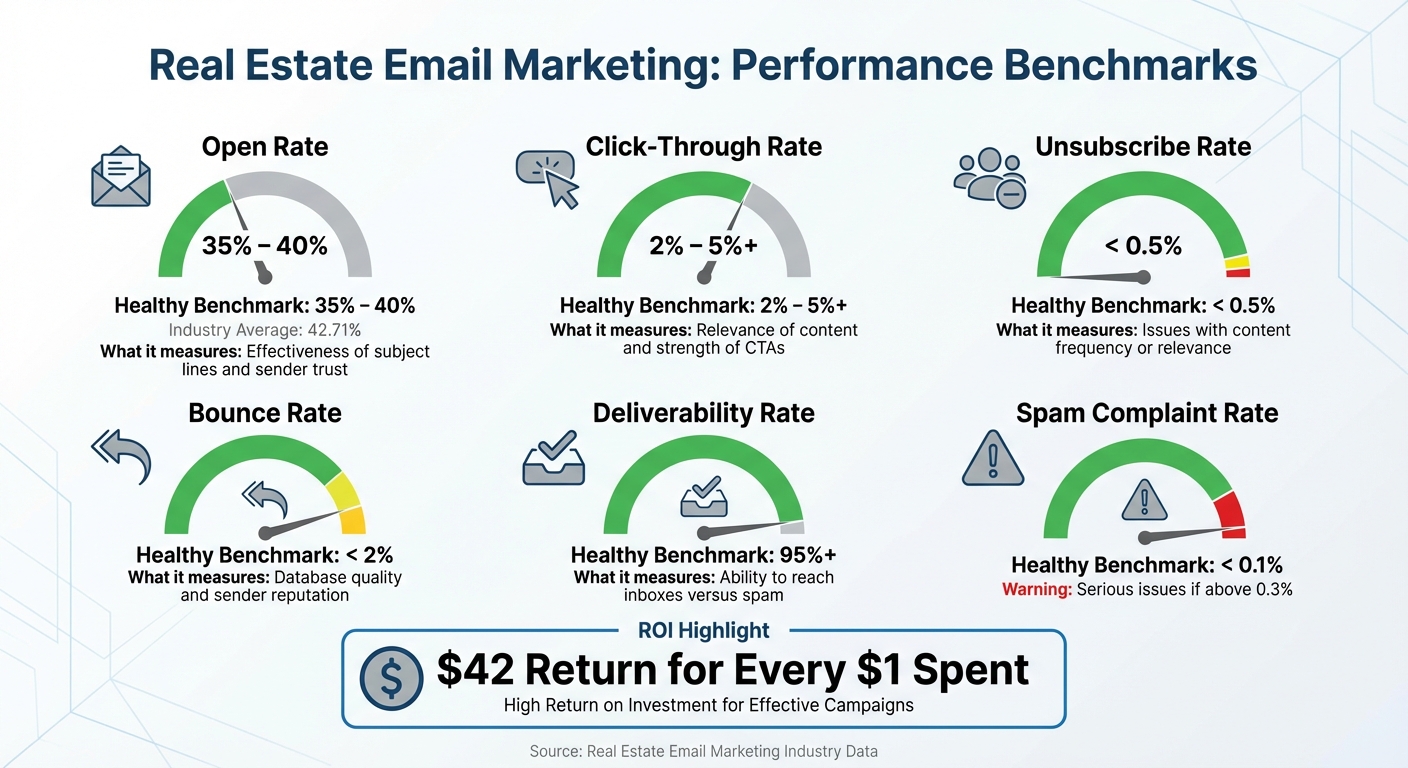
To gauge your campaign’s effectiveness, focus on metrics that matter. Start with deliverability and open rates, then assess engagement (click-through rates) and conversions like scheduled consultations or property inquiries. On average, the real estate industry sees an open rate of about 42.71%, with strong campaigns achieving 35-40%. Click-through rates typically fall between 2% and 5%, though well-optimized dynamic campaigns often surpass these benchmarks.
| Metric | Healthy Benchmark | What It Reveals |
|---|---|---|
| Open Rate | 35% – 40% | Effectiveness of subject lines and sender trust |
| Click-Through Rate | 2% – 5%+ | Relevance of content and strength of CTAs |
| Unsubscribe Rate | < 0.5% | Issues with content frequency or relevance |
| Bounce Rate | < 2% | Database quality and sender reputation |
| Deliverability Rate | 95%+ | Ability to reach inboxes versus spam |
| Spam Complaint Rate | < 0.1% | Serious issues if above 0.3% |
For deeper insights, consider engagement scoring, which tracks multiple interactions across channels to identify high-intent leads. Email marketing boasts an impressive ROI – around $42 for every $1 spent. However, to fully capture this value, focus on metrics that tie directly to business outcomes, not just vanity stats. Using multi-touch attribution can help you understand how dynamic email campaigns contribute to conversions, even if those conversions occur through phone calls or in-person meetings.
Conclusion
The examples shared in this article highlight one clear takeaway: dynamic email content has the power to transform real estate marketing. Instead of sending out generic messages, it allows agents to create personalized, engaging conversations. Features like real-time price updates and tailored recommendations don’t just capture attention – they drive higher engagement and revenue. This makes dynamic content a game-changer for real estate professionals looking to elevate their messaging.
But it’s not just about immediate results. Dynamic content helps build stronger, long-term relationships. For instance, 39% of sellers forget who their previous agent was. By sending hyper-local market updates, behavioral triggers for new listings, and tailored property suggestions based on actual search habits, you position yourself as more than just another agent – you become a trusted advisor. This kind of personalized communication helps bridge gaps and sets the foundation for smoother, automated workflows.
On top of that, dynamic content boosts efficiency. Behavioral-triggered workflows let you nurture leads at scale, freeing up your time to focus on closing deals. These streamlined processes, combined with a strong return on investment, highlight the business benefits of personalized, dynamic email marketing.
Growth-Realty’s AI-powered email tools make it easy for real estate professionals to put these strategies into action. With features like automated behavioral triggers and optimized send times, Growth-Realty’s tools help you stay connected with clients while scaling your results. By combining personalized insights with automation, Growth-Realty represents the future of email marketing in real estate.
The era of static email blasts is over. Personalized, dynamic content is already reshaping the way real estate professionals engage with buyers and sellers. Those who embrace this shift will stand out, earning the trust and business of clients who expect relevance in every message.
FAQs
How does using dynamic content make real estate emails more effective?
Dynamic content transforms real estate emails into highly personalized experiences, catering to each recipient’s specific preferences and their stage in the buying or selling journey. Instead of sending out generic emails, you can include tailored property recommendations, neighborhood highlights, or market updates. These personalized touches grab attention and lead to higher open rates and more clicks.
It doesn’t stop there. Dynamic content also makes automation smarter. Think about follow-up emails, open house invites, or market reports triggered by a user’s activity or location – this kind of targeted communication keeps interactions timely and relevant. The result? Leads are nurtured more effectively, trust grows, and conversions increase. By combining AI with audience segmentation, real estate professionals can craft emails that feel personal and actionable, building stronger client connections and delivering better outcomes.
How do behavioral triggers enhance dynamic email campaigns in real estate?
Behavioral triggers are a powerful way to craft email campaigns that feel both timely and personal. By reacting to specific actions – like browsing a property, asking for a home valuation, or interacting with certain content – real estate professionals can deliver messages that align perfectly with a lead’s current interests and stage in their buying or selling journey.
Take this example: if a potential buyer is repeatedly checking out listings in a particular neighborhood, you can set up an automated email to share similar properties or provide local market updates. This strategy not only keeps the lead engaged but also improves the chances of conversion by ensuring your communication feels relevant and actionable. Using behavioral triggers allows you to nurture leads more efficiently, saving time while achieving better results.
How can AI improve personalization in real estate email marketing?
AI tools are reshaping real estate email marketing by making communication more personalized and relevant. By examining client preferences, past behaviors, and engagement patterns, AI helps craft content that truly connects with each recipient. This might mean creating attention-grabbing subject lines, offering property suggestions tailored to individual interests, or adjusting email timing to align with a client’s stage in the buying process.
These AI-driven capabilities allow real estate businesses to send emails that feel timely and personal, fostering meaningful connections and boosting engagement. The result? A better client experience and higher conversion rates – key advantages in a highly competitive market.

